
Speaker Diarization vs Transcription: Who Spoke When?
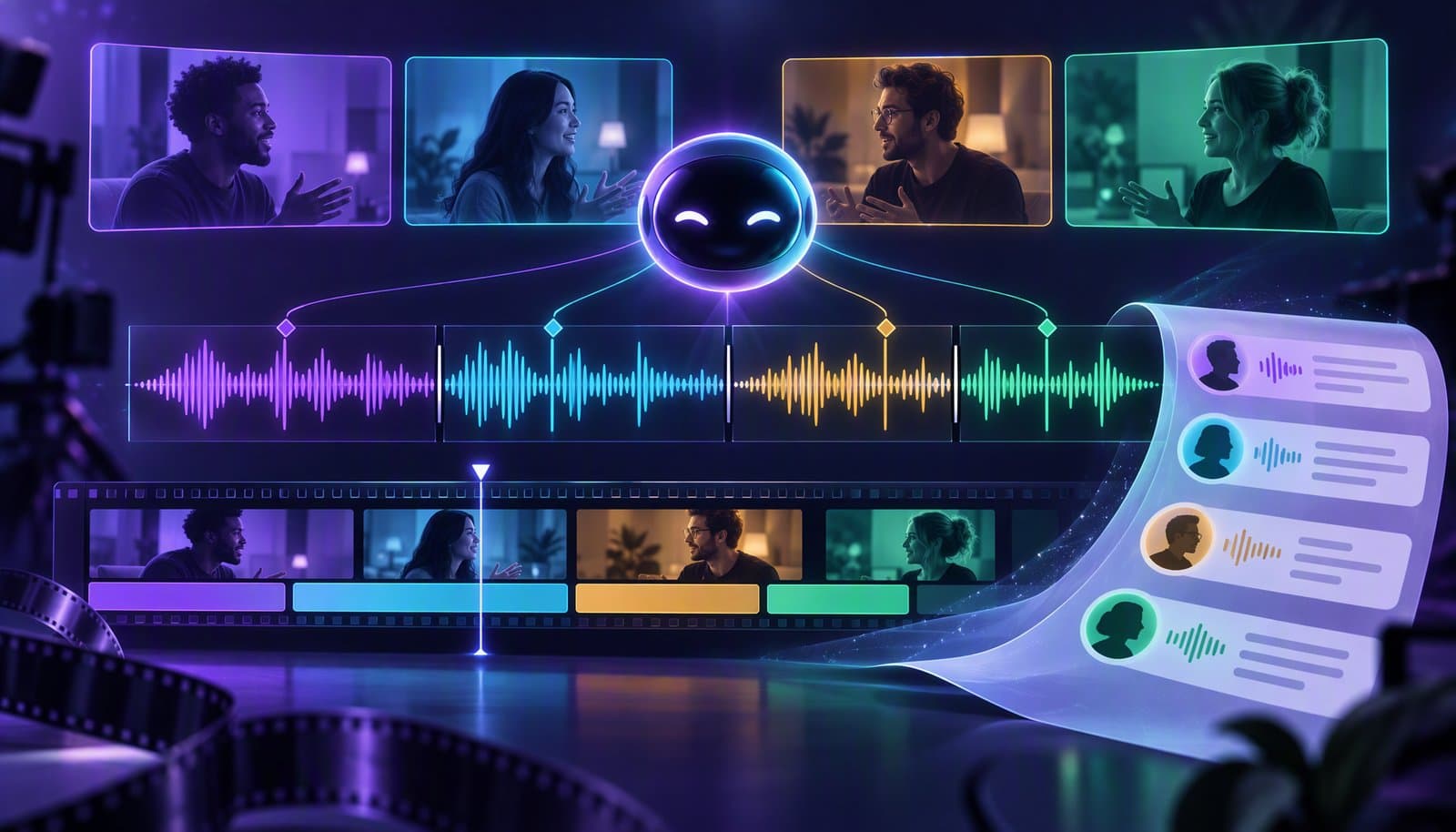
Transcription converts speech into written words. Speaker diarization groups speech into speaker-labeled time intervals: who spoke when, usually as anonymous labels such as Speaker 1 and Speaker 2. Combining them produces a speaker-attributed transcript. Diarization does not inherently discover real names, isolate voices into separate audio files, or synchronize multiple cameras; those require additional information and capabilities.
An interview transcript can spell every sentence correctly and still attribute the key answer to the wrong guest. Conversely, a system can group two voices consistently while misunderstanding a product name. These failures come from different tasks, so they need different checks.
This guide explains the tasks separately before combining them into an editorial workflow. All sample recordings, labels, and calculations below are hypothetical teaching examples, not measured performance from Loopdesk or any cited model. For a shorter starting point, see the video transcription glossary entry.
Six tasks that often get confused
Automatic speech recognition, or ASR, estimates the words in an audio signal. A transcription service may also add punctuation, language detection, timestamps, or speaker labels, but those extra outputs should not be assumed from the word “transcription.” A plain paragraph answers what was said without necessarily saying when or by whom.
Diarization estimates speech regions and assigns consistent speaker cluster labels within a recording or defined session. “Speaker 1” means a group of segments the system treats as belonging together. It does not mean the system knows a person's civil identity. Even the order of numbered labels may change between runs or files.
| Task | Main question | Typical output | Important non-equivalence |
|---|---|---|---|
| ASR or transcription | What words were spoken? | Words or sentences, sometimes with timestamps | Correct words do not prove correct speaker attribution |
| Speaker diarization | Which speaker cluster was active when? | Start/end intervals with anonymous labels | A cluster label is not a verified name |
| Speaker identification | Does this speech match a known person? | A proposed identity using enrollment or other evidence | Ordinary diarization does not supply that evidence |
| Source separation | Can mixed sources be estimated separately? | Separate audio waveforms or stems | Labeling time intervals does not unmix the recording |
| Voice activity detection, or VAD | Where is speech present? | Speech/non-speech regions or probabilities | Two simultaneous speakers can still occupy one speech region |
| Forced alignment | Where does supplied text fit the audio? | Estimated word or phoneme boundaries | Alignment does not establish that the supplied words are correct |
These distinctions are not newly invented marketing categories. NIST's Rich Transcription program separately describes speech-to-text, speaker diarization, speech activity detection, and speaker-attributed transcription tasks. An application can combine them without making them interchangeable.
Forced alignment is especially easy to misunderstand. Given a recording and a corrected transcript, it estimates where the known words occur. The Montreal Forced Aligner workflow documentation illustrates this distinct alignment operation. If the transcript contains a sentence that was never spoken, a forced aligner is not a reliable truth detector; the mismatch still needs review.
Identification also differs from a human assigning a display name to a verified cluster. Listening to an introduced guest and renaming their cluster is editorial annotation. Comparing an unknown voice against enrolled voice examples is a separate recognition system with additional evaluation, privacy, and consent questions.
How a diarization pipeline works
A useful mental model has four operations, although modern systems may combine stages or learn them jointly. The original pyannote.audio paper describes building blocks for voice activity, speaker changes, overlap, and speaker embeddings. It supports this breakdown, not a claim that every implementation uses one identical architecture.
First, the system analyzes short spans of audio and estimates speech activity or local speaker activity. This is where quiet words can disappear and background sounds can become false detections. A pause does not automatically mean a new speaker; a speaker change does not require a pause.
Second, it computes representations of voices, often called speaker embeddings. An embedding is a numerical representation intended to help compare voice characteristics. It is not a hidden name tag. Microphone response, room acoustics, duration, noise, and changes in vocal delivery can affect how similar two excerpts appear.
Third, a clustering or related assignment method groups regions that likely belong to the same speaker. Too much merging can turn two participants into one cluster. Too much splitting can give a single person separate labels when they laugh, whisper, move away from the microphone, or return after an edit. Knowing the participant count can help constrain some models, but supplying the wrong count can force errors.
Fourth, the system refines timing and reconciles local decisions across the recording. An overlap-aware output can have more than one active speaker at a time. Some workflows additionally produce an exclusive, non-overlapping representation to make joining words to labels easier. That is a representation choice, not evidence that simultaneous speech never occurred.
The pyannote Community-1 model card explicitly documents both regular diarization and an exclusive diarization output. It also documents optional speaker-count constraints. These are capabilities of that particular pipeline; their presence there does not establish which backend or controls another product uses.
To produce a diarized transcript, a workflow must associate ASR words with these speaker intervals. A simple rule might assign a word to the speaker covering most of its duration. That can work in clear turns, but becomes ambiguous at boundaries or during overlap. If an ASR word spans both sides of a speaker change, the system's neat label can conceal a genuine timing disagreement.
Preserve the original analysis when making a display-friendly version. Collapsing two active labels to one may simplify paragraphs, but it removes information that could matter for quotation review, captions, or overlap analysis. A readable transcript and a faithful multi-speaker annotation are related deliverables, not necessarily the same data structure.
Why overlap and channel layout change the problem
A mono recording contains one combined waveform. When two people speak simultaneously, the system receives their mixture, not two clean voice files. It may detect both speakers, recognize only the louder words, or miss a quieter interruption. More confident formatting cannot recover evidence that the recording did not preserve clearly.
Separate microphone tracks can provide stronger evidence about who contributed a sound, provided the tracks are genuinely isolated and correctly mapped. They still need inspection for bleed, room echo, swapped inputs, a guest using someone else's microphone, and inconsistent start times. A channel identifies a recording path, not inherently a person.
| Recording layout | What it gives you | What to check before analysis |
|---|---|---|
| One mono room microphone | A shared mixture of the room | Distance, reverberation, quieter voices, and overlap |
| Stereo file containing a final mix | Two channels, possibly with nearly the same speech | Whether left and right actually separate participants |
| One participant isolated on each channel | Channel information that can support attribution | Bleed, channel mapping, and whether the tool preserves channels |
| Separate remote participant files | Potentially cleaner individual speech | Offsets, dropouts, processing differences, and clock drift |
| Mixed program audio with music and clips | The finished listening experience | Archival voices, sung vocals, and speaker changes inside inserted material |
Do not equate “stereo” with “two speakers.” A stereo music bed under one narrator is still one narrator. A stereo podcast mix may place every speaker in both channels. Conversely, four separate files may contain one person recorded with four microphones.
Model input behavior matters. Community-1's card says it uses mono audio at 16 kHz and automatically averages multichannel input to mono. Passing isolated left and right microphones into that pipeline as one stereo file therefore does not preserve their separation. A different multichannel-aware workflow may exploit it; verify the actual tool rather than assuming the file layout survives ingestion.
Resampling to a model's expected sample rate is different from deleting time. Correct resampling preserves duration. Removing silences, shortening pauses, or changing playback speed changes the time map. If analysis runs on a shortened copy, its timestamps cannot be applied directly to the original recording without a mapping back.
Multiple cameras introduce another layer. Diarization can describe speaker activity on an audio clock, but it does not align camera starts, correct drifting clocks, or identify which shot best covers that person. Audio-to-camera mapping, synchronization, visual speaker association, and editing policy must be implemented and checked separately.
A hypothetical recording with labels and timestamps
Consider an invented 20-second recording with two speakers, A and B. A human reference identifies the active speakers and representative words. A hypothetical system outputs anonymous labels S0 and S1. The words column describes the reference scene only; it is not an ASR output or a claim about word accuracy.
Times are elapsed seconds from this recording's start. Intervals include their start and exclude their end, so an event exactly on a boundary is not counted twice. For the calculation that follows, the entire 0–20-second region is evaluated, overlapping speech is included, and no boundary collar is removed.
| Interval in seconds | Reference activity and representative words | Hypothetical system labels | Review finding |
|---|---|---|---|
| 0.000–2.000 | No speech | None | Correct non-speech |
| 2.000–6.000 | A: Welcome to the recording. | S0 | Four seconds correctly grouped with A |
| 6.000–9.000 | B: The draft is ready. | S1 | Three seconds correctly grouped with B |
| 9.000–10.000 | A: Wait. B: Yes? Both speak simultaneously. | S1 only | B retained; one second of A missed |
| 10.000–13.000 | B: Please check the title. | S0 | Three seconds assigned to the wrong speaker |
| 13.000–15.000 | No speech; room noise | S1 | Two seconds of false speaker activity |
| 15.000–19.000 | A: I will check it now. | S0 | Four seconds correctly grouped with A |
| 19.000–20.000 | No speech | None | Correct non-speech |
Across the full example, the best one-to-one correspondence maps S0 to A and S1 to B. That mapping is established from the pattern of matching time, not by comparing the literal strings “A” and “S0.” Otherwise, a system using different arbitrary labels would be penalized for naming conventions rather than diarization quality.
A contributes 4 + 1 + 4 = 9 seconds of reference speech. B contributes 3 + 1 + 3 = 7 seconds. There are 16 reference speaker-seconds but only 15 elapsed seconds containing any speech, because one second contains both voices. The recording is 20 seconds long; these three durations answer different questions.
The decimal places are deliberately precise for arithmetic, not a claim that an AI has located real boundaries to the nearest millisecond. Real turn boundaries can be uncertain even for annotators. If an output prints 9.237 seconds, the displayed precision alone says nothing about whether the relevant onset actually happened at 9.237 seconds.
Measure diarization errors without confusing them with word errors
Diarization error rate, or DER, combines missed speaker activity, false speaker activity, and speaker confusion. The pyannote.metrics reference defines the denominator as the sum of reference speech durations over speakers. NIST's md-eval scoring implementation exposes missed speaker time, false-alarm speaker time, and speaker error time separately.
For a fixed evaluation region and scoring policy:
DER = (missed speaker time + false-alarm speaker time + speaker-confusion time) / reference speaker time.
This is duration-based accounting after matching anonymous system labels to reference speakers. In overlap-aware scoring, missing one of two active speakers incurs missed speaker time even though speech is detected throughout. Similarly, an extra active speaker can create false-alarm speaker time in a region that already contains genuine speech.
Calculate DER for the hypothetical recording
| Component | Where it occurs | Duration |
|---|---|---|
| Missed speaker time | A is absent from the output during the 9–10-second overlap | 1 speaker-second |
| False-alarm speaker time | S1 is active during non-speech at 13–15 seconds | 2 speaker-seconds |
| Speaker confusion | B's speech at 10–13 seconds is assigned to S0, mapped to A | 3 speaker-seconds |
| Reference speaker time | A contributes 9 seconds and B contributes 7 seconds | 16 speaker-seconds |
DER is therefore (1 + 2 + 3) / 16 = 6 / 16 = 37.5%. Dividing by the 20-second file would give 30%, but that would be the wrong denominator for this DER calculation. The three seconds of confusion are not also counted as three missed seconds plus three false-alarm seconds in this example.
This result is intentionally easy to audit and intentionally not a benchmark. It does not predict performance on podcasts, meetings, interviews, or any product. With little reference speech and substantial false activity, DER can exceed 100%; it is not a universal “percentage of time correct” bounded like a simple accuracy score.
State the scoring policy before comparing numbers
A forgiveness collar removes time around reference boundaries from scoring. For example, a protocol might exclude 250 milliseconds before and after each boundary. That can remove small timing disagreements, but also changes the evaluated material and denominator. State the excluded interval explicitly: tools can differ in whether a collar parameter describes a half-width or full width.
Also state whether overlapping reference speech is scored, which regions have reference annotations, how labels are mapped, and whether the speaker count was supplied. Ignoring overlap can hide exactly the behavior that matters in lively discussions. Community-1's published model-card evaluation explicitly reports no forgiveness collar and no skipped overlap; that context belongs with its numbers.
For a collection of recordings, summing error durations and reference speaker durations before dividing produces a duration-weighted aggregate. Averaging each file's DER equally answers a different question. Keep the dataset, recording layout, model version, reference rules, and scoring configuration fixed for a meaningful comparison. A score without those conditions is not enough to choose a workflow.
Calculate WER separately
Word error rate, or WER, counts substitutions, deletions, and insertions relative to a reference word sequence. NIST's SCTK sclite documentation describes reference/hypothesis text alignment and word errors. Ordinary WER is not a diarization metric.
For a separate hypothetical example, the reference is “we ship on Friday morning,” containing five words. The hypothesis is “we ship Friday evening.” Deleting “on” and substituting “evening” for “morning” gives (0 insertions + 1 deletion + 1 substitution) / 5 = 40% WER, under case-normalized, punctuation-free word comparison.
Neither sentence contains speaker labels, so this calculation cannot evaluate them. A transcript can have 0% ordinary WER while attributing a quote to the wrong person. Conversely, DER's label matching can give a perfect grouping score even if a human later attaches the wrong real names consistently. Evaluate words, grouping, verified names, and timing as separate requirements.
Improve the recording before tuning the model
Record each speaker clearly and consistently where possible. Keep microphone distance reasonably stable, monitor for clipping, and reduce room echo at capture. A loud waveform is not necessarily intelligible: raising gain raises room noise too, and clipped consonants are not restored by adding more decimal places to timestamps.
For remote discussions, isolated participant recordings and headphones can reduce problems caused by speakerphone echo and heavily mixed conference audio. Listen to the actual files after recording. A file bearing a participant's name can still contain missing audio, another participant's return feed, or a reconnect that changes its clock relationship.
Do not assume aggressive cleanup improves every model. Noise reduction or voice enhancement can suppress quiet syllables, change vocal texture, or introduce artifacts. Compare an authorized sample before and after processing, including soft speech and overlap rather than only the clean introduction. Our noise reduction vs voice enhancement guide explains why those processing goals should not be treated as identical.
Preserve the original and document every transformation. If you remove silence from a video, retain the edit mapping or rerun analysis against the final timeline. Do not apply shortened-audio timestamps to untouched footage.
Timestamp precision should be checked against provider specifications and listening evidence. Google's word-timestamp documentation describes 100-millisecond increments for the documented Cloud Speech-to-Text interface. That is a scoped API behavior, not a universal limit or a claim of 100-millisecond accuracy. Formatting a value with three fractional digits does not improve its underlying estimate.
A review workflow that keeps people and words separate
The workflow below is tool-independent. It does not imply that every application exposes cluster merging, word-level exports, isolated-track analysis, or editable speaker mappings. Confirm the required controls before depending on them.
-
Define the deliverable and permission boundary. Decide whether you need a readable transcript, searchable words, accessible captions, anonymous research annotations, or approved named quotations. Establish recording and processing permissions, the allowed service, retention, and who can see the output. Save the original media identifier and exact version so later corrections refer to the same material.
-
Inspect channels and choose an analysis copy. Listen to each channel separately if available. Record channel-to-participant mappings from confirmed production information, not file count alone. Keep duration unchanged unless you retain a reversible time mapping. Test the difficult passages: introductions, short acknowledgments, laughter, overlapping discussion, remote dropouts, and inserted clips.
-
Correct the transcript as words. Check names, numbers, jargon, negations, and code-switching against the audio and approved reference materials. Do not silently rewrite a hesitant answer into a confident one. Mark uncertain or masked speech rather than inventing a plausible sentence. If forced alignment is used afterward, verify its boundaries around edited text and unusual vocabulary.
-
Correct clusters before naming people. Review repeated examples of each label across the recording. Merge labels only when they are the same verified speaker; split a label when it contains different speakers. Then attach approved names or roles using introductions, production notes, or human confirmation. A global rename is not a fix for a cluster that mixes two people. Preserve an anonymous label where identity remains unresolved.
-
Reconcile words, turns, and overlap. Inspect words crossing speaker boundaries rather than trusting a sentence-wide assignment. If both speakers contribute important content, preserve the overlap in the underlying annotation and create an appropriate readable representation. Keep source time, final-edit time, and review notes distinct. A corrected display paragraph should not erase evidence needed to revisit an uncertain attribution.
-
Check the exported use case. Listen while reading the actual transcript or captions, and inspect every consequential quote. Confirm that corrected names and timestamps survive export. For captions, add meaningful sound information and suitable cue breaks; our captions, subtitles, and SDH guide explains that additional work. For video edits, review picture and audio on the timeline instead of treating a speaker boundary as an automatic cut command.
Record unresolved cases and who approved the final version. If the picture or soundtrack changes afterward, review the affected mappings again. “Reviewed transcript” should identify a specific deliverable and revision, not become a permanent quality label attached to every later export.
Troubleshooting and tool-selection decisions
Look for the kind of error before changing model settings. A wrong word may need better ASR or vocabulary review; a correct sentence under the wrong person needs attribution review. Increasing an expected speaker count will not necessarily solve either one.
| Symptom | Likely issue to investigate | Focused response |
|---|---|---|
| One person appears as several speakers | Over-splitting after voice, microphone, or acoustic changes | Compare recurring examples before merging verified same-speaker clusters |
| Two participants share one label | Over-merging, short samples, similar voices, or incorrect count constraints | Review turn boundaries and isolated tracks; split only with evidence |
| A quiet “yes” belongs to the wrong person | Short backchannel, overlap, or word/turn boundary mismatch | Listen with surrounding context and inspect both timing layers |
| Labels change between separately processed clips | File-local clustering or restarted label assignment | Build a verified cross-clip mapping rather than equating label numbers |
| The output reports speech during music or room noise | False activity detection or voices embedded in the program | Inspect that region and separate genuine recorded speech from false detections |
| Words are accurate but quotations are misattributed | Diarization or human naming error | Correct grouping and identity mapping separately; WER will not settle it |
| Speaker labels look right but camera cuts are wrong | Missing synchronization, visual mapping, or unsuitable edit policy | Check the multicamera workflow independently of audio diarization |
When choosing a tool, request a representative, permitted trial and inspect the actual output you will receive. Does it expose individual turns or only paragraph labels? Can uncertain spans stay unassigned? Can you correct one mistaken turn without renaming a whole cluster? Are overlaps retained? Do exported words carry timestamps in a documented timebase?
Decide what matters for the deliverable. A one-speaker narration may need transcription and timing but little clustering. A panel with interruptions needs careful attribution and overlap review. A request for isolated voice files requires source separation or original tracks, not just a diarization checkbox. A requirement for legal-grade named quotations needs verification beyond either a low WER or DER.
Do not convert a small internal trial into a published universal benchmark. Note the recording conditions, sample selection, errors found, and correction effort. That record is more useful for your decision than an unsupported claim that a tool “recognizes everyone accurately.”
Privacy, consent, and Loopdesk capability limits
Audio, transcripts, embeddings, and identity mappings can all be sensitive. A transcript makes names and private remarks easier to search and copy. Speaker embeddings may create additional privacy or biometric-data considerations depending on how they are used and the applicable jurisdiction. Calling a label anonymous does not guarantee that the underlying recording is anonymous.
Establish recording consent and an appropriate basis for processing and publication before sending material to a service. Review retention, deletion, access controls, model-training terms, and whether processing is local or hosted. Local processing can reduce external disclosure, but does not replace device security or permission to analyze the material. This is practical risk guidance, not universal legal advice.
Do not infer ethnicity, health, religion, sexuality, or other sensitive characteristics from a voice. Do not publish a guessed real name because a model produced a confident label. Use approved names, confirmed roles, or neutral identifiers, and keep an “uncertain” state when the evidence does not justify attribution.
Disclosure: Loopdesk is our product, and this article is written by the Loopdesk Team. The Loopdesk feature specifications describe transcription, speaker detection, and speaker-centered reframing. Those descriptions do not establish a particular diarization model, user-adjustable clustering, DER performance, enrolled voice recognition, source-separated audio exports, or automatic synchronization of separate camera recordings.
The pyannote and NIST references explain the field; they are not evidence that Loopdesk runs those exact models or scoring tools. Check the current product interface and documentation for the specific import, correction, export, and synchronization operations your workflow requires. A general speaker-detection capability does not prove every downstream operation is shipped.
For the wider editing vocabulary, see video editing terminology explained and text-based video editing explained. Having a transcript also does not automatically mean that deleting its words will cut the footage.
Delivery checklist
- Record the approved source version, soundtrack, channel layout, and time origin for every analysis output.
- Confirm recording, processing, sharing, and publication permissions; restrict transcripts and identity mappings appropriately.
- Verify important words independently of labels, especially names, numbers, negations, and quoted claims.
- Inspect recurring examples of every speaker cluster across the recording, not only the introductions.
- Correct split and merged clusters before applying verified names or roles; leave unsupported identities unresolved.
- Review overlap, short acknowledgments, offscreen contributions, and inserted recordings where attribution is fragile.
- Check timestamps by listening and comparing events, including after edits; do not infer accuracy from printed precision.
- If reporting metrics, disclose reference regions, overlap handling, collars, label mapping, aggregation, and model configuration.
- Confirm that corrections survive the actual export, and assess captions or multicamera edits as additional deliverables.
- Keep the original annotation, correction history, and final approval tied to the released version, with an appropriate retention policy.
Frequently asked questions
Does transcription tell you who is speaking?
Not necessarily. Transcription estimates words. A service must also perform diarization or use verified channel information to attach speakers. Even then, anonymous speaker labels need a separate, evidence-based mapping before they become real names.
Can diarization identify unknown speakers by real name?
No, not inherently. Diarization groups speech using anonymous labels. Real names require reliable context, human confirmation, or a separate identification system with appropriate reference information. A cluster number is not identity evidence.
Is speaker diarization the same as source separation?
No. Diarization produces speaker-labeled time intervals. Source separation estimates separate audio waveforms from a mixture. A transcript labeled Speaker 1 and Speaker 2 does not mean clean individual voice files are available.
Can two speakers have overlapping diarization segments?
Yes. Overlap-aware diarization can mark multiple speakers active at once. Some systems also offer an exclusive representation with one active speaker at a time. That simplified output should not be mistaken for proof that the recording has no overlap.
Does stereo audio make speaker attribution easy?
Only if the channels genuinely provide useful separation and the analysis preserves it. A stereo mix may contain every speaker in both channels. Separate tracks also need checks for bleed, channel mapping, offsets, and drift.
What is the difference between DER and WER?
DER measures missed speaker time, false speaker time, and speaker confusion relative to reference speaker time. WER measures word substitutions, deletions, and insertions. Correct words can still be assigned to the wrong person.
Do millisecond timestamps guarantee accurate boundaries?
No. Decimal precision describes how a timestamp is represented, not how accurately the event was located. Check the model or API timing specification and verify relevant boundaries against the recording, especially near overlap and short words.
Can diarization synchronize multiple camera recordings?
Not by itself. Diarization describes speaker activity on an audio timeline. Aligning camera starts, correcting clock drift, associating speakers with shots, and choosing cuts require separate synchronization and editing capabilities.
How should a human correct wrong speaker labels?
Check recurring examples, split clusters that mix people, and merge labels only when they belong to the same verified speaker. Then apply approved names or roles. Renaming an entire mixed cluster can spread the error instead of correcting it.
Sources
Primary references checked for this guide on September 14, 2026. Model-card features and API timing behavior apply to the named implementations, not to all transcription products.
- NIST: Rich Transcription Evaluation — separate transcription, diarization, speech-activity, and speaker-attributed tasks.
- Bredin and colleagues: pyannote.audio — primary paper describing neural diarization building blocks.
- pyannote: Community-1 model card — input downmixing, speaker-count constraints, regular/exclusive output, and evaluation policy.
- pyannote.metrics: Reference — DER components, reference speaker-time denominator, optimal label mapping, collars, and overlap handling.
- NIST SCTK: md-eval source — primary speaker-time scoring implementation and scoring options.
- NIST SCTK: sclite documentation — reference/hypothesis word alignment and transcription error scoring.
- Google Cloud Speech-to-Text: Get word timestamps — word-offset output and documented timing increments for that API interface.
- Montreal Forced Aligner: Alignment workflows — alignment using supplied text and acoustic models.