
What Is Agentic Video Editing? AI Agents Explained (2026 Guide)
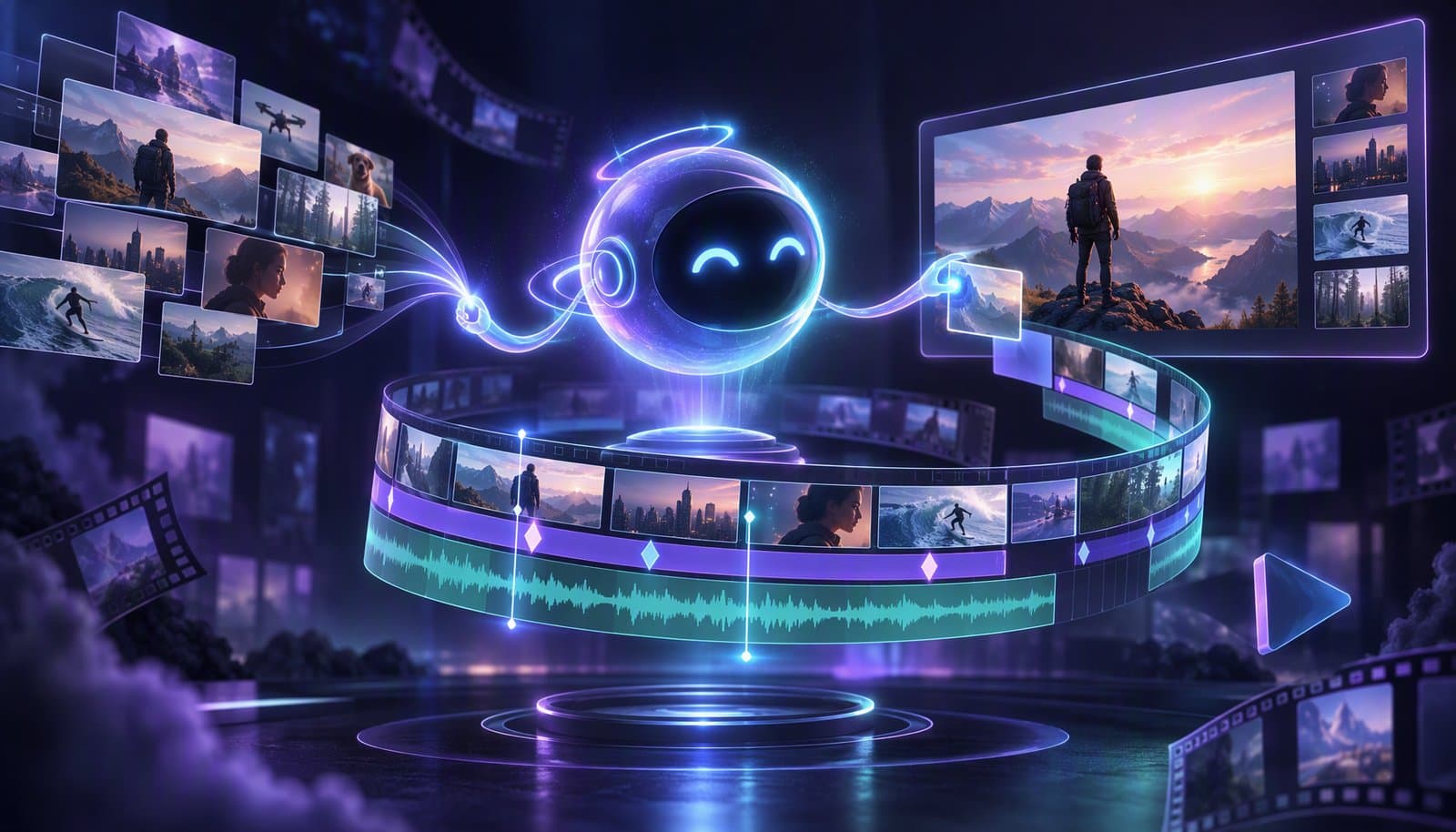
Agentic video editing is a workflow where an AI agent, not a human operator, plans and executes the edit. You give the agent a goal in natural language ("turn this podcast into a captioned episode plus five vertical clips") and it works through every step on its own: analysis, cutting, captioning, reframing, and export.
If 2024 was the year AI features showed up inside video editors, and 2025 was the year the first real editing agents shipped, then 2026 is the year agentic video editing became a category with a name. This post explains what that name actually means, and why it isn't just marketing gloss on auto-captions.
What Is Agentic Video Editing?
Agentic editing comes down to three properties. Together they separate it from every AI feature that came before:
- Goal-directed autonomy. You specify the outcome, not the operations. The agent breaks "make this episode publishable" into transcription, silence removal, caption styling, thumbnail moments, and export, then sequences those steps itself.
- Content understanding. The agent works from a semantic model of your footage: who's speaking, what they're saying, where the emotional peaks are. It builds that model with speech-to-text and visual understanding. It doesn't just see waveforms and frames.
- Iterative direction. You refine results conversationally. "Tighter cuts in the intro." "Make the captions less flashy." "Find a better hook for clip two." Each note updates the agent's sense of your taste.
The mental model we find most useful: a traditional editor is a tool you operate. An assistive AI is a feature you trigger. An agent is a collaborator you direct.
What Makes an Agentic AI Video Editor Different?
An agentic AI video editor owns the plan as well as the individual edits. A conventional AI video editor waits for separate commands to transcribe, cut, caption, and export; an agent turns one outcome into that entire sequence, checks its work, and responds to creative feedback.
How Do AI Video Editing Agents Work?
An editing agent runs on a loop that will look familiar if you've followed AI agents in software development:
| Loop Stage | What Happens in a Video Agent |
|---|---|
| Perceive | Ingest footage; build the transcript, speaker map, scene index, and content-type profile |
| Plan | Translate your prompt into an ordered list of editing operations |
| Act | Execute those operations on the timeline: cuts, captions, reframes, audio, effects |
| Verify | Check the result against the goal (caption sync, clip length limits, platform specs) |
| Learn | Fold your feedback into the next iteration |
Two things make this loop work for video now, when it would've fallen apart in 2023. First, multimodal models can genuinely watch footage. Scene detection, speaker detection, and emotion-aware highlight scoring are now reliable enough to act on without a human double-checking every call. Second, browser technologies like WebGPU and WebCodecs let all of this run in a browser-based editor with desktop-class performance, so the agent's edits render instantly instead of round-tripping through a render farm.
What Can an Editing Agent Do Today?
Concretely, here's what creators hand off to Loopdesk's agent, Aura, in 2026:
- Full first cuts. "Edit this 90-minute recording into a clean episode" produces a rough cut with silences, filler words, and retakes removed.
- Multi-output repurposing. One long recording becomes captioned vertical clips, a mid-length YouTube cut, and quote graphics, all through content repurposing.
- Archive mining. The agent digs through your back catalog for evergreen moments that match whatever's trending this week.
- Style-consistent captioning. Auto captions in 108 languages that pick up your brand fonts and colors.
- Batch operations. The same instruction applied across 50 videos at once. Batch editing is honestly where agents embarrass manual workflows the most.
- Platform-aware export. One-click distribution with the right specs for each platform.
Agentic vs Assistive vs Automated: Clearing Up the Terms
These three words get blurred together in marketing copy, and the differences matter when you're choosing tools:
| Automated Editing | Assistive AI | Agentic Editing | |
|---|---|---|---|
| Who plans the edit? | A fixed template | You | The agent |
| Scope | One predefined pipeline | One task at a time | Multi-step, open-ended goals |
| Input | Upload only | Clicks + occasional prompts | Natural language direction |
| Adapts to feedback? | No | Per-task | Conversationally, across the project |
| Example | Auto-generated slideshow | "Transcribe this clip" | "Make this episode publishable and give me 5 shorts" |
Or, less formally: automated editing is a vending machine. Assistive AI is power steering. Agentic editing is a chauffeur who learns your favorite routes.
What Are the Pros and Cons of Agentic Video Editing?
| Pros | Cons |
|---|---|
| Executes complete, multi-step edits from one goal | Still needs human review for story, taste, and factual judgment |
| Applies consistent direction across large batches | Depends on accurate transcripts and footage analysis |
| Makes revisions conversational instead of mechanical | Requires an internet connection in browser-based tools |
| Frees creators to focus on the decisions audiences notice | Fine-grained keyframing and compositing still suit a traditional NLE |
The practical trade-off is control at the operation level versus control at the outcome level. Agentic workflows are strongest when the goal is clear and repetitive work is high; manual tools still win when every frame needs custom craft.
Why Agentic Workflows Are Winning in 2026
The economics are hard to argue with. When we studied 250 podcasters, the same pattern kept showing up: creators spend 4-8 hours editing for every hour of recorded content, and the ones burning out are the ones doing that work by hand. The creators who switched to an agentic "director" workflow were producing 3-5x more content in about a fifth of the editing time. Not by lowering their standards, but by delegating the mechanical 80% of the work and spending their attention on the creative 20%.
There's a structural reason agents win, too: they scale horizontally. A human editor works one timeline at a time. An agent applies the same creative direction across an entire archive, which is why creators with a big content library see the largest gains. As we argued in our piece on the rise of agentic AI, this isn't about replacing an editor's judgment. It's about removing the ceiling on how far that judgment can reach. It is also the first of our 10 AI video editing trends for 2026.
How to Try Agentic Editing
The fastest way to understand agentic editing is to direct an agent for ten minutes:
- Open Loopdesk in your browser. There's nothing to install.
- Upload one long-form recording. A podcast, webinar, or interview works best.
- Give the agent one compound goal: "Remove silences and filler words, add captions, and create three vertical highlight clips."
- Review the output, then push back on one thing: "Clip two starts mid-thought. Find a cleaner hook."
Step 4 is where the category clicks. You're not operating software anymore. You're directing an editor.
Frequently Asked Questions
What does agentic mean in video editing?
"Agentic" means the AI acts as an autonomous agent: it plans and executes multi-step editing workflows toward a goal you describe, rather than waiting for you to trigger individual features. The agent perceives your footage, plans operations, acts on the timeline, and adapts to your feedback.
What is the difference between AI video editing and agentic video editing?
AI video editing is the umbrella term for any ML-powered editing capability, including single features like auto-captions. Agentic video editing specifically means an AI agent chains those capabilities together on its own (analysis, cutting, captioning, reframing, export) from one natural language instruction.
Which video editors have AI agents in 2026?
Loopdesk is built agent-first. Its agent, Aura, executes complete editing workflows from prompts. Traditional editors like Premiere Pro and DaVinci Resolve have added assistive AI features (text-based editing, voice isolation) but still expect you to operate the timeline. Our 12-tool comparison covers the full landscape.
Are agentic workflows only useful for long-form creators?
No, but they compound with volume. If you publish one short video a week, an agent saves you an evening. If you run a podcast, a course library, or a multi-platform clip strategy, agents are the difference between shipping and drowning.
Direct your first edit today. Open Loopdesk's agentic editor: describe the edit, then watch it happen.